
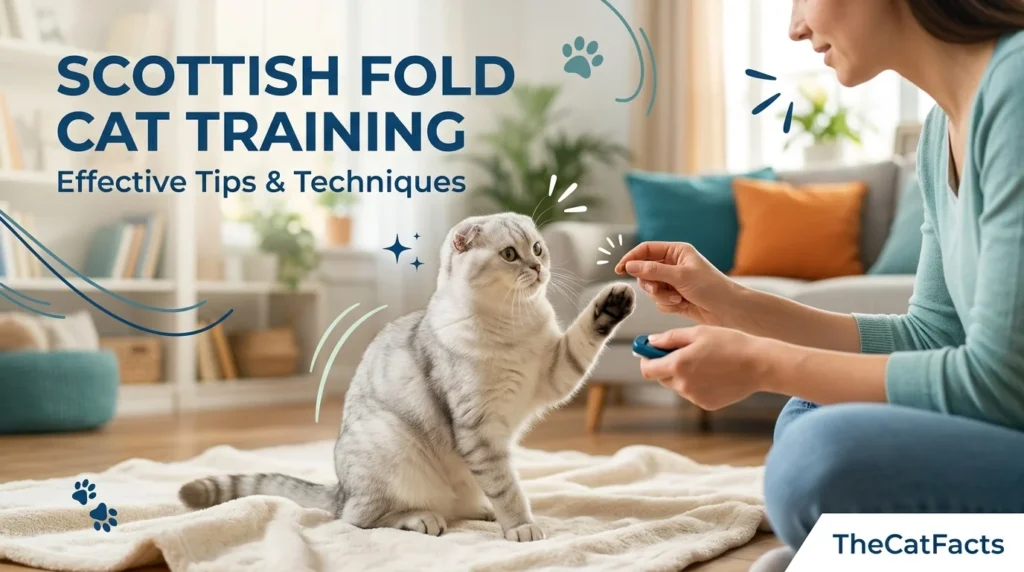
Scottish Fold cats are intelligent, affectionate, and adaptable companions that can learn a variety of good habits when trained with patience and positive reinforcement. While they are not as energetic as some other cat breeds, they enjoy interactive learning sessions that strengthen their bond with their owners. Effective training helps prevent unwanted behaviors, supports mental stimulation, and creates a happier home for both cats and families.
Many people mistakenly believe cats cannot be trained. In reality, Scottish Folds respond well to rewards, routines, and gentle encouragement. Their calm personality often makes them easier to train than highly independent breeds, provided training starts early and remains consistent.
This guide explains everything you need to know about Scottish Fold cat training, from litter box basics and scratching habits to clicker training, leash walking, and solving common behavior problems. It also includes veterinary insights, practical tips, safety advice, and expert recommendations to help your cat succeed.
Can Scottish Fold Cats Be Trained?
Yes, Scottish Fold cats can be trained successfully using positive reinforcement, consistency, and short daily sessions. They enjoy learning when rewards are motivating and training remains fun rather than stressful.
Scottish Folds inherit a curious and social personality that allows them to learn household rules, simple commands, and interactive games. Their affectionate nature means they often enjoy working with their owners instead of avoiding training sessions.
Although every cat has its own personality, most Scottish Folds can learn:
- Litter box habits
- Proper scratching behavior
- Basic commands
- Recall training
- Target training
- Carrier acceptance
- Nail trimming cooperation
- Leash walking
- Puzzle toy interaction
- Household routines
Training is not about making your cat behave like a dog. Instead, it teaches useful behaviors while improving trust and communication.
Understanding the Scottish Fold Personality
Knowing your cat’s personality helps you choose training methods that match its learning style.
Calm and Gentle Nature
Scottish Folds are generally calm cats that prefer peaceful environments. They may become overwhelmed by loud noises or chaotic households, so training works best in quiet settings.
Highly Food Motivated
Many Scottish Folds love treats. Small healthy rewards often make training much easier.
Choose treats that are:
- Small
- Soft
- Low calorie
- High protein
Avoid overfeeding, since this breed can gain weight easily.
Intelligent but Independent
Scottish Folds understand routines quickly, but they may refuse repetitive exercises if they become bored.
Keep sessions:
- Fun
- Short
- Reward based
- Varied
Sensitive to Stress
Unlike some bold breeds, Scottish Folds may shut down if punished or frightened.
Never use:
- Yelling
- Physical punishment
- Spray bottles
- Fear-based correction
- Harsh restraint
Stress damages trust and makes learning much slower.
When Should You Start Training a Scottish Fold?
Training should begin as soon as your kitten arrives home, usually around 8 to 12 weeks of age.
Early experiences shape lifelong habits, making kittenhood the easiest time to teach positive behaviors.
| Age | Training Goals |
| 8 to 12 weeks | Litter box, gentle handling, socialization |
| 3 to 4 months | Scratching post, recall, name recognition |
| 4 to 6 months | Clicker training, basic commands |
| 6 to 12 months | Leash introduction, tricks, puzzle games |
| Adult | Reinforce habits and learn advanced skills |
Older Scottish Fold cats can also learn successfully. Adult cats may simply require more patience.
Why Training Is Important
Training provides more than good manners.
It improves both physical and emotional health.
Mental Stimulation
Interactive learning keeps your cat’s brain active.
Benefits include:
- Less boredom
- Better confidence
- Improved curiosity
- Reduced destructive behavior
Stronger Bond
Training teaches your cat that good things happen when interacting with you.
Many owners notice increased trust after consistent reward-based training.
Better Veterinary Care
Cats trained to accept handling are often less stressed during:
- Veterinary examinations
- Nail trimming
- Grooming
- Ear cleaning
- Medication
Improved Household Behavior
Training reduces many common frustrations, including:
- Furniture scratching
- Counter jumping
- Excessive meowing
- Door rushing
- Inappropriate chewing
Essential Supplies for Scottish Fold Cat Training
Having the right equipment makes training easier.
| Training Supply | Purpose |
| Soft treats | Reward good behavior |
| Clicker | Marks desired actions |
| Target stick | Guides movement |
| Scratching post | Redirects scratching |
| Wand toys | Builds motivation |
| Interactive puzzles | Mental enrichment |
| Cat harness | Safe outdoor practice |
| Treat pouch | Quick reward delivery |
Avoid equipment designed to punish cats.
How Cats Learn
Understanding feline learning principles increases training success.
Cats repeat behaviors that produce positive outcomes.
If sitting earns a reward, the behavior becomes more frequent.
If scratching the sofa feels good and nothing changes, the scratching continues.
Training focuses on rewarding desirable behavior rather than punishing unwanted actions.
Positive Reinforcement
Positive reinforcement means rewarding behaviors you want repeated.
Rewards include:
- Treats
- Praise
- Playtime
- Petting
- Favorite toys
This method is recommended by veterinary behavior experts because it strengthens trust and encourages learning.
Timing Matters
Reward your cat within one or two seconds of the desired behavior.
Delayed rewards confuse the learning process.
Consistency Builds Habits
Every family member should use the same commands and reward system.
Mixed signals slow progress.
Preparing Your Home for Training
Creating a comfortable learning environment helps your Scottish Fold focus.
Choose a Quiet Space
Select a room with:
- Few distractions
- Low noise
- Comfortable temperature
- Familiar surroundings
Cats learn better when they feel secure.
Keep Sessions Short
Most Scottish Folds stay engaged for:
- 3 to 5 minutes for kittens
- 5 to 10 minutes for adults
Several short sessions each day are far more effective than one long lesson.
End on Success
Finish training after a successful behavior.
Ending positively keeps your cat eager for the next session.
Teaching Your Scottish Fold Its Name
Name recognition is one of the first skills every cat should learn.
Step 1
Say your cat’s name in a cheerful voice.
Step 2
The moment your cat looks toward you, reward immediately.
Step 3
Repeat several times each day.
Soon your Scottish Fold will associate its name with positive experiences.
Avoid using your cat’s name during punishment, as this creates negative associations.
Litter Box Training
Most Scottish Fold kittens naturally learn litter box habits from their mother, but reinforcement is still important.
Choosing the Right Litter Box
A good litter box should be:
- Easy to enter
- Large enough to turn around
- Placed in a quiet location
- Clean every day
Many cats prefer uncovered litter boxes because they provide better visibility and ventilation.
Encouraging Good Habits
Place kittens in the litter box:
- After meals
- After naps
- After play sessions
Reward successful use with praise or a small treat.
Common Litter Box Mistakes
Avoid these problems:
- Dirty litter
- Strong scented litter
- Too few litter boxes
- Busy locations
- Frequent box changes
Veterinarians generally recommend one litter box per cat, plus one extra.
Teaching Proper Scratching Behavior
Scratching is a normal feline behavior.
It helps cats:
- Stretch muscles
- Maintain claw health
- Mark territory
- Reduce stress
The goal is to redirect scratching rather than stop it.
Choosing the Best Scratching Post
Look for posts that are:
- Tall enough to stretch fully
- Stable
- Covered in sisal
- Positioned near favorite resting areas
Some Scottish Folds also enjoy horizontal scratching pads.
Reward Correct Scratching
Whenever your cat uses the scratching post:
- Offer praise
- Give a treat
- Play with a favorite toy
Positive experiences encourage repetition.
Prevent Furniture Damage
Discourage furniture scratching by:
- Covering attractive surfaces temporarily
- Placing scratching posts nearby
- Using cat-safe deterrents if needed
- Keeping claws trimmed regularly
Never punish scratching, since it is a natural behavior.
Clicker Training for Scottish Fold Cats
Clicker training uses a small device that makes a clicking sound to mark the exact behavior you want.
The click tells your cat, “Yes, that is correct.”
Charging the Clicker
Before teaching commands:
- Click.
- Give a treat immediately.
- Repeat 15 to 20 times.
Your cat soon learns that every click predicts a reward.
Benefits of Clicker Training
Clicker training offers several advantages.
- Faster learning
- Clear communication
- Less confusion
- Greater confidence
- Easier trick training
- Stronger owner and cat relationship
Because the click always sounds the same, it is often more precise than using your voice.
Teaching Basic Commands
Scottish Fold cats can learn several practical commands with patience and repetition.
Sit
Hold a treat slightly above your cat’s nose and slowly move it backward. As your cat naturally lowers its hindquarters into a sitting position, click and reward immediately. Repeat until the movement becomes consistent, then introduce the verbal cue “Sit.”
Come
Call your cat’s name followed by the word “Come” in a cheerful tone. Reward every successful response with a favorite treat or brief play session. Practice from short distances first, then gradually increase the distance as your cat becomes more reliable.
High Five
Use a treat to encourage your cat to lift one paw. The instant the paw touches your hand, click and reward. With regular practice, many Scottish Folds learn to offer their paw on cue.
Touch
Present a target stick or your fingertip a few inches from your cat’s nose. Most cats will naturally sniff the target. Click and reward the moment the nose makes contact. Target training forms the foundation for many advanced behaviors.
Stay Patient
Some cats master new commands within days, while others need several weeks. Progress depends on personality, age, motivation, and consistency. Avoid rushing the process, and celebrate small improvements to keep training enjoyable.
Teaching Your Scottish Fold to Use a Cat Carrier
Many cats dislike carriers because they only see them before veterinary visits. Carrier training changes that association by making the carrier a safe and rewarding space.
Step 1: Leave the Carrier Out
Place the carrier in a quiet room where your cat spends time.
Keep the door open and add:
- A soft blanket
- Favorite toys
- Catnip (if your cat enjoys it)
- Comfortable bedding
Allow your cat to explore at its own pace.
Step 2: Reward Exploration
Whenever your Scottish Fold enters or investigates the carrier:
- Offer a treat
- Give gentle praise
- Toss another treat inside
Never force your cat into the carrier during training.
Step 3: Practice Closing the Door
Once your cat is comfortable relaxing inside:
- Close the door for a few seconds.
- Reward calm behavior.
- Open the door before your cat becomes anxious.
Gradually increase the amount of time the door remains closed.
Step 4: Practice Short Trips
Carry the closed carrier around your home before taking short car rides.
This helps reduce stress during future veterinary visits.
Harness and Leash Training
Some Scottish Fold cats enjoy supervised outdoor adventures when trained properly.
Benefits of Harness Training
A properly fitted harness allows safe outdoor exploration while reducing the risk of escape.
Benefits include:
- Mental stimulation
- Physical exercise
- New experiences
- Reduced boredom
- Safe environmental enrichment
Never attach a leash to a collar alone, as cats can easily slip out.
Introducing the Harness
Allow your cat to:
- Sniff the harness
- Investigate it freely
- Receive treats near it
Once comfortable, gently place the harness on your cat for a minute or two indoors.
Gradually increase wearing time over several days.
Adding the Leash
Attach the leash indoors first.
Allow your cat to walk freely while dragging the lightweight leash under supervision.
Once relaxed, begin gently guiding your cat with rewards.
Only move outdoors after your cat appears confident inside.
Teaching Recall
Recall training teaches your cat to come when called.
This can improve safety indoors and outdoors.
How to Teach Recall
- Say your cat’s name.
- Use the word “Come.”
- Reward immediately when your cat reaches you.
- Repeat daily.
- Gradually increase distance.
Never call your cat for unpleasant experiences such as nail trimming or medication.
Target Training
Target training teaches your cat to touch an object with its nose or paw.
This simple behavior can later be used to teach complex tricks.
Benefits include:
- Easier trick training
- Better focus
- Mental stimulation
- Confidence building
Target training is especially useful for shy Scottish Fold cats.
Teaching Fun Tricks
Scottish Fold cats often enjoy learning simple tricks that provide mental exercise.
Popular tricks include:
- Spin
- Wave
- High five
- Jump onto a stool
- Ring a bell
- Sit pretty
- Fetch lightweight toys
- Enter the carrier on cue
Keep trick sessions enjoyable rather than demanding.
Socialization Training
Early socialization helps Scottish Fold kittens grow into confident adult cats.
Introduce New People
Allow visitors to approach calmly.
Never force interaction.
Reward your cat whenever it remains relaxed around new people.
Introduce Household Sounds
Expose your cat gradually to:
- Vacuum cleaners
- Doorbells
- Television
- Kitchen appliances
- Hair dryers
Begin with low volume whenever possible.
Pair unfamiliar sounds with treats and play.
Introducing Other Pets
Successful introductions require patience.
Begin by:
- Swapping bedding
- Allowing scent exchange
- Using baby gates
- Supervising brief meetings
Do not rush introductions.
Some cats need several weeks before becoming comfortable.
Preventing Unwanted Behaviors
Most behavior problems can be prevented through enrichment, consistency, and understanding your cat’s needs.
Scratching Furniture
Instead of punishment:
- Provide multiple scratching posts
- Reward appropriate scratching
- Trim nails regularly
- Place posts near favorite furniture
Counter Jumping
Cats naturally seek high places.
Provide alternatives such as:
- Cat trees
- Wall shelves
- Window perches
Reward your cat for using approved climbing areas.
Biting During Play
Never encourage rough hand play.
Instead use:
- Wand toys
- Balls
- Interactive toys
- Feather toys
Stop play briefly if biting occurs.
Resume only after calm behavior returns.
Excessive Meowing
Excessive vocalization may indicate:
- Hunger
- Stress
- Loneliness
- Medical illness
- Boredom
If sudden excessive meowing develops, schedule a veterinary examination to rule out health problems.
Common Training Mistakes
Many owners unintentionally slow their cat’s progress.
Avoid these common mistakes.
| Mistake | Better Approach |
| Punishing mistakes | Reward correct behavior |
| Long training sessions | Keep sessions under 10 minutes |
| Inconsistent commands | Use the same words every time |
| Too many treats | Use tiny healthy rewards |
| Training when cat is tired | Train during active periods |
| Expecting instant results | Be patient and consistent |
How Long Does It Take to Train a Scottish Fold?
Most cats begin learning basic behaviors within one to three weeks of regular practice.
More advanced skills may require several months.
Training speed depends on:
- Age
- Personality
- Motivation
- Health
- Consistency
- Previous experiences
Remember that every cat learns at its own pace.
Creating a Daily Training Routine
A predictable routine helps your Scottish Fold understand what to expect.
| Time | Activity |
| Morning | Five minutes of command practice before breakfast |
| Afternoon | Interactive play and puzzle feeders |
| Evening | Clicker training and trick practice |
| Night | Calm handling and grooming practice |
Short, regular sessions are more effective than occasional long sessions.
Mental Enrichment Beyond Training
Training is only one part of keeping your Scottish Fold mentally healthy.
Provide daily enrichment through:
- Puzzle feeders
- Window perches
- Cat trees
- Rotating toys
- Food puzzles
- Hide-and-seek games
- Safe climbing areas
Mental exercise helps reduce boredom and destructive behaviors.
Signs Your Scottish Fold Is Enjoying Training
Cats communicate through body language.
Positive signs include:
- Relaxed ears
- Upright tail
- Slow blinking
- Curious behavior
- Willingness to return for another session
- Accepting treats eagerly
These signs indicate your cat feels comfortable and engaged.
Signs Your Cat Is Becoming Stressed
Stop training if your cat shows signs of stress.
Watch for:
- Flattened ears
- Dilated pupils
- Tail flicking
- Growling
- Hissing
- Hiding
- Refusing treats
- Attempting to escape
Resume training later when your cat is relaxed.
Veterinary Considerations During Training
Scottish Folds have unique health considerations due to the genetic mutation responsible for their folded ears.
Some cats develop joint problems that may affect movement and comfort.
Avoid asking your cat to repeatedly:
- Jump from high surfaces
- Stand upright for long periods
- Perform physically demanding tricks
- Complete excessive exercise sessions
If your Scottish Fold appears reluctant to move, limps, or shows signs of pain during training, discontinue the activity and consult your veterinarian. Pain can interfere with learning and may indicate conditions such as Scottish Fold osteochondrodysplasia or arthritis.
Regular veterinary checkups help ensure your cat remains healthy enough for training and exercise.
Expert Tips for Successful Scottish Fold Training
- Start training as early as possible.
- Keep sessions short and enjoyable.
- Reward good behavior immediately.
- Use healthy treats in moderation.
- Train before mealtime for better motivation.
- End every session on a positive note.
- Be patient and avoid punishment.
- Rotate toys to maintain interest.
- Practice commands in different rooms.
- Respect your cat’s physical limits.
Training Checklist
Use this checklist to monitor your Scottish Fold’s progress.
- Responds to its name
- Uses the litter box consistently
- Uses scratching posts
- Comes when called
- Accepts gentle handling
- Enters the carrier willingly
- Allows nail trimming
- Wears a harness comfortably
- Knows basic commands
- Plays appropriately without biting
- Remains calm around visitors
- Enjoys daily enrichment activities
A completed checklist reflects not only good training but also a confident, well-adjusted cat.
Conclusion
Training a Scottish Fold cat is one of the best ways to build trust, encourage good behavior, and provide essential mental stimulation. With positive reinforcement, consistency, and patience, these gentle and intelligent cats can learn everything from basic household manners to fun tricks and useful life skills. Remember that every cat learns at its own pace, and success comes from making each session enjoyable rather than demanding.
By combining reward-based training with proper healthcare, environmental enrichment, and regular veterinary visits, you can help your Scottish Fold become a happy, confident, and well-behaved companion for many years.
FAQs
How easy is it to train a Scottish Fold cat?
Scottish Fold cats are generally easy to train because they are intelligent, calm, and enjoy interacting with their owners. They respond best to positive reinforcement, short training sessions, and consistent routines. Starting training during kittenhood usually produces the fastest results, although adult cats can also learn successfully.
At what age should I start training a Scottish Fold kitten?
You can begin training when your Scottish Fold kitten comes home, usually between 8 and 12 weeks of age. Start with simple habits such as litter box use, name recognition, gentle handling, and scratching post training before moving on to basic commands and clicker training.
Can Scottish Fold cats learn tricks?
Yes, Scottish Fold cats can learn many tricks, including sit, high five, spin, come when called, touch, and even fetch. Using treats, praise, and clicker training makes learning enjoyable and helps your cat understand which behaviors earn rewards.
How long should each training session be?
Training sessions should be short to keep your cat interested. Kittens usually benefit from sessions lasting 3 to 5 minutes, while adult Scottish Fold cats can focus for about 5 to 10 minutes. Several short sessions throughout the day are more effective than one long session.
Should I use punishment if my Scottish Fold misbehaves?
No. Punishment can create fear, anxiety, and confusion, making training less effective. Veterinary behavior experts recommend rewarding good behavior and redirecting unwanted actions instead of yelling, spraying water, or using physical corrections.
Can Scottish Fold cats be leash trained?
Yes, many Scottish Fold cats can learn to wear a harness and walk on a leash with gradual training. Begin indoors using a properly fitted cat harness, reward calm behavior, and slowly introduce outdoor walks only after your cat is comfortable and confident.
Why is my Scottish Fold ignoring training?
Your cat may be distracted, tired, stressed, or not motivated by the reward you are offering. Try using higher value treats, training before meals, shortening sessions, and practicing in a quiet environment. If your cat suddenly becomes unwilling to participate, consult your veterinarian to rule out pain or illness.
What are the best treats for Scottish Fold training?
Small, soft, high-protein treats work best because they are easy to eat quickly without interrupting the training session. Since Scottish Fold cats can gain weight easily, use tiny portions and adjust daily food intake to avoid overfeeding.
Can older Scottish Fold cats still be trained?
Yes. Adult and senior Scottish Fold cats are fully capable of learning new behaviors, although they may require more repetition and patience than kittens. Positive reinforcement and consistent routines remain effective regardless of age.
Are Scottish Fold cats good for first-time cat owners?
Yes, Scottish Fold cats are often considered an excellent choice for first-time owners because of their gentle temperament and willingness to bond with people. With proper training, socialization, enrichment, and regular veterinary care, they can become affectionate, well-mannered companions.

Amelia Scott is a Cat Breed Specialist with more than 12 years of experience researching feline breeds, cat behavior, breed characteristics, and responsible cat ownership. She specializes in studying the history, temperament, appearance, health considerations, and unique traits of different cat breeds to create accurate and informative resources for cat lovers.