
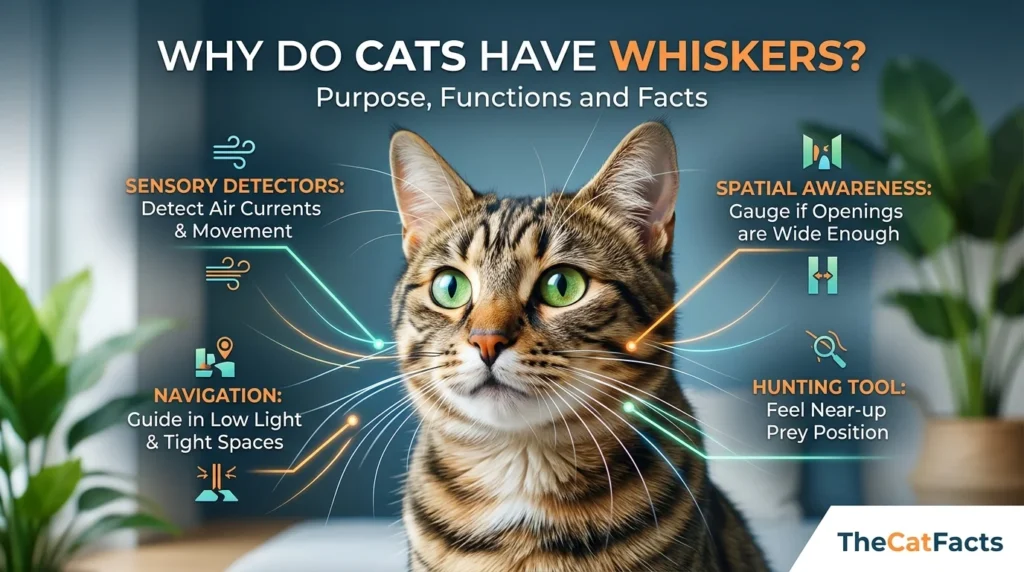
Cats use their whiskers to explore their surroundings, judge spaces, detect movement, and protect themselves. These special hairs are far more than decoration. They are highly sensitive sensory tools that help cats hunt, climb, navigate in the dark, and communicate their emotions.
Whether your cat is a playful kitten or an older indoor companion, healthy whiskers play an important role in daily life. Understanding how whiskers work helps owners provide better care and avoid common mistakes, such as trimming them.
In this guide, you’ll learn what cat whiskers are, why they are so important, how they help cats survive, and why they grow in several locations on the body.
What Are Cat Whiskers?
Cat whiskers are specialized sensory hairs that help cats gather information about their environment. Unlike ordinary fur, whiskers are thicker, stiffer, and deeply rooted in the skin. Veterinarians refer to whiskers as vibrissae, a term used for touch-sensitive hairs found in many mammals.
Each whisker connects to a follicle surrounded by nerves, muscles, and blood vessels. This makes whiskers incredibly sensitive to even the slightest touch or movement.
Instead of feeling with their paws or noses first, cats often use their whiskers to examine unfamiliar objects. A gentle brush against a surface sends signals directly to the brain, helping the cat understand what is nearby.
What Makes Whiskers Different From Normal Hair?
Although whiskers look like long hairs, they function very differently.
| Feature | Whiskers | Normal Fur |
| Thickness | Thick and stiff | Thin and soft |
| Root depth | Deep in the skin | Shallow |
| Nerve endings | Thousands | Few |
| Main purpose | Sensing surroundings | Insulation and protection |
| Movement | Controlled by facial muscles | Mostly passive |
Because whiskers are packed with nerve endings, they act like tiny antennas that constantly collect information.
What Are Vibrissae?
The scientific name vibrissae refers to the long tactile hairs found on cats, dogs, seals, rodents, and several other mammals.
Unlike ordinary hairs, vibrissae can detect:
- Air currents
- Nearby obstacles
- Texture changes
- Vibrations
- Small movements of prey
- Narrow openings
These abilities make whiskers one of the cat’s most important sensory organs.
How Do Cat Whiskers Work?
Cat whiskers work by detecting tiny changes in the environment and sending those signals to the brain. The whiskers themselves do not contain nerves. Instead, the follicle at the base is surrounded by numerous sensory nerve endings.
When a whisker bends or moves, these nerves send electrical signals to the brain almost instantly.
Sensitive Follicles
Each whisker grows from a specialized follicle filled with:
- Blood vessels
- Sensory receptors
- Muscle fibers
- Dense nerve networks
This unique structure allows cats to notice objects before making direct contact with them.
Detecting Air Movement
Cats can sense subtle air movements created by:
- Moving insects
- Running mice
- Opening doors
- Approaching animals
- Objects in front of them
Even in complete darkness, whiskers help cats build a mental map of nearby objects by detecting changes in airflow.
Helping the Brain Create a Map
The cat’s brain processes whisker signals very quickly.
Information from the whiskers combines with input from the eyes, ears, nose, and paws to create an accurate picture of the environment.
Researchers have found that a large area of the feline brain is devoted to processing information received from the whiskers.
Whiskers Move Independently
Cats can move their whiskers forward, backward, or sideways using tiny facial muscles.
Forward whiskers often indicate:
- Curiosity
- Hunting
- Investigation
- Play
Relaxed whiskers usually suggest the cat feels calm and comfortable.
Flattened whiskers may appear when a cat feels frightened, stressed, or defensive.
Why Do Cats Have Whiskers?
Cats have whiskers because they are essential sensory tools that improve navigation, hunting, balance, and communication. Without healthy whiskers, many everyday activities become more difficult.
Measuring Narrow Spaces
One of the most well-known jobs of whiskers is measuring openings.
The longest facial whiskers are usually about as wide as the cat’s body. Before squeezing through a gap, the cat often positions its whiskers forward to estimate whether it will fit safely.
This reduces the risk of becoming stuck.
Hunting Prey
Whiskers are extremely valuable during hunting.
When prey gets close to the cat’s face, it may move out of the cat’s direct line of sight.
Whiskers help locate prey by detecting:
- Tiny movements
- Vibrations
- Air displacement
- Body position
This allows the cat to deliver an accurate bite, even in low light.
Navigating in the Dark
Cats have excellent night vision, but their eyesight still has limits.
Whiskers provide additional information by detecting nearby surfaces before the body touches them.
This helps cats:
- Walk through dark rooms
- Avoid furniture
- Climb safely
- Explore unfamiliar places
Protecting the Eyes
Whiskers above the eyes serve an important protective function.
When these whiskers touch grass, branches, or other objects, they often trigger a blink reflex that helps shield the eyes from injury.
Maintaining Balance
Contrary to a common myth, whiskers are not the primary organ responsible for balance. The inner ear performs that role.
However, whiskers contribute by giving the brain extra information about body position and nearby surfaces, especially during climbing and jumping.
Social Communication
Cats also use whiskers to express emotions.
Different whisker positions can indicate different moods.
| Whisker Position | Possible Meaning |
| Relaxed | Calm and content |
| Forward | Curious, playful, focused |
| Pulled back | Nervous or fearful |
| Flattened tightly | Defensive or aggressive |
Owners should observe whiskers together with body posture, ears, tail, and vocalizations rather than relying on whiskers alone.
Types and Locations of Cat Whiskers
Cats have whiskers in several locations across their body, and each group serves a different purpose. Most people notice the long whiskers on the cheeks, but there are several other important sets.
Mystacial Whiskers
These are the long whiskers growing from both sides of the muzzle.
They help cats:
- Detect nearby objects
- Measure spaces
- Locate prey
- Explore unfamiliar environments
These are the whiskers most people recognize.
Supraorbital Whiskers
These are the whiskers located above the eyes.
Their main job is protecting the eyes and detecting objects approaching from above.
Genal Whiskers
These whiskers grow on the cheeks.
They provide additional sensory information while helping cats judge nearby surfaces.
Mandibular Whiskers
These shorter whiskers grow beneath the chin.
They help cats inspect objects located below the face, including food, toys, and prey.
Carpal Whiskers
Many owners never notice these whiskers because they grow on the back of the front legs near the wrists.
Carpal whiskers help during:
- Climbing
- Holding prey
- Walking over uneven surfaces
- Judging object position while using the paws
Cat Whisker Locations at a Glance
| Whisker Type | Location | Primary Function |
| Mystacial | Muzzle | Navigation and measuring spaces |
| Supraorbital | Above the eyes | Eye protection and obstacle detection |
| Genal | Cheeks | Environmental awareness |
| Mandibular | Chin | Detecting objects below the face |
| Carpal | Front legs | Climbing, hunting, and paw coordination |
Why Do Cats Have Whiskers on Their Head?
Cats have whiskers on different parts of their head because each set collects information from a unique direction. Together, these whiskers provide nearly 360-degree awareness of nearby objects.
Improved Environmental Awareness
Whiskers positioned around the face allow cats to detect movement coming from:
- The front
- The sides
- Above the head
- Below the chin
This complete sensory system helps cats react quickly to changes in their surroundings.
Better Hunting Accuracy
When chasing prey, head whiskers help determine the exact location of an animal after it comes within close range.
This is especially useful because prey often moves beneath the cat’s nose, where vision is less effective.
Safer Movement
Head whiskers reduce accidental collisions with:
- Walls
- Tree branches
- Furniture
- Plants
- Other animals
Indoor cats benefit just as much as outdoor cats because they constantly navigate around household obstacles.
Communication With Other Cats
Whisker position is part of feline body language.
Cats often move their facial whiskers during:
- Friendly greetings
- Play sessions
- Hunting
- Defensive encounters
Watching whisker movement alongside ear and tail position provides valuable clues about a cat’s emotional state.
Why Do Cats Have Whiskers Above Their Eyes?
Cats have whiskers above their eyes to protect their vision and detect objects approaching the face. These whiskers act like an early warning system, helping prevent injuries during exploration, climbing, and hunting.
They Trigger Protective Blinking
The whiskers above the eyes are extremely sensitive.
When they touch leaves, branches, grass, or other objects, they can trigger a rapid blink reflex. This automatic response helps reduce the risk of scratches or debris reaching the eyes.
Outdoor cats benefit from this feature while moving through bushes, tall grass, and wooded areas. Indoor cats also rely on these whiskers when exploring furniture, shelves, and tight spaces.
They Detect Obstacles Before Contact
Supraorbital whiskers extend slightly beyond the forehead and can sense nearby objects before they make direct contact with the eyes.
This helps cats:
- Avoid eye injuries
- Move safely through narrow spaces
- Navigate in dim lighting
- Explore unfamiliar environments with confidence
They Improve Spatial Awareness
Whiskers above the eyes work together with the cheek, chin, and leg whiskers to create a detailed picture of the surroundings.
This combined sensory information allows cats to judge distances accurately while climbing, jumping, stalking prey, or moving around obstacles.
They Support Hunting and Exploration
During hunting, these whiskers help detect movement near the upper part of the face, particularly when prey is hidden in grass or vegetation.
Combined with excellent hearing, vision, and smell, they give cats remarkable precision when tracking and capturing prey.
Why Do Cats Have Whiskers for Kids?
Cats have whiskers to help them feel their way around, just like people use their hands to touch things. Whiskers help cats know where objects are, whether they can fit through a space, and if something is moving nearby.
Think of whiskers as tiny superhero sensors. They help cats stay safe while exploring, especially in the dark.
Whiskers Help Cats Find Their Way
Cats can see well in low light, but they still need extra help when it gets very dark.
Their whiskers can:
- Feel nearby objects
- Detect walls and furniture
- Help avoid bumping into things
- Guide them through narrow spaces
This is why cats can move so quietly around the house at night.
Whiskers Help Cats Hunt
Wild cats and pet cats both have natural hunting instincts.
Their whiskers help them notice:
- Tiny insects
- Mice
- Birds
- Moving toys
Even if a toy is very close to their face, whiskers help them know exactly where it is.
Whiskers Protect Their Eyes
The long whiskers above a cat’s eyes help protect them.
If a branch, leaf, or object touches these whiskers, the cat quickly blinks before the object reaches its eye.
Never Cut a Cat’s Whiskers
Kids sometimes wonder if whiskers are like haircuts.
The answer is no.
Whiskers should never be trimmed because they help cats understand the world around them. Cutting them can make a cat confused and less confident while moving.
Fun Facts About Cat Whiskers
| Fun Fact | Explanation |
| Cats are born with whiskers | Kittens use whiskers from birth to explore. |
| Whiskers are very sensitive | They can detect tiny movements in the air. |
| Cats usually have about 24 facial whiskers | Most have 12 on each side of the face. |
| Whiskers naturally fall out | Losing one occasionally is normal. |
| New whiskers grow back | Healthy whiskers usually replace old ones over time. |
Do Cat Whiskers Hurt When Cut?
Cutting a cat’s whiskers does not hurt like cutting hair because the whisker itself has no pain receptors. However, trimming whiskers can seriously affect a cat’s ability to navigate and interact with its surroundings.
Although the whisker shaft cannot feel pain, its deep root is connected to a highly sensitive follicle filled with nerves and blood vessels.
Why Cutting Whiskers Is Harmful
Whiskers provide constant information about the environment.
After trimming, a cat may struggle to:
- Judge distances
- Measure openings
- Climb safely
- Catch toys or prey
- Move confidently in dim light
Some cats become hesitant or anxious because an important sense has been reduced.
Signs a Cat May Be Affected After Whisker Trimming
Not every cat reacts the same way, but possible changes include:
- Walking more cautiously
- Bumping into furniture
- Refusing to jump
- Appearing startled more often
- Becoming less playful
- Showing signs of stress
These effects are usually temporary until the whiskers grow back.
What Is Whisker Stress?
Whisker stress, sometimes called whisker fatigue, is different from cutting whiskers.
It happens when whiskers repeatedly press against the sides of deep food or water bowls.
Some cats dislike this constant stimulation and may:
- Eat less
- Paw food onto the floor
- Prefer drinking from wide bowls
- Leave food unfinished
Using wide, shallow dishes can help reduce whisker stress in sensitive cats.
Can Cutting Whiskers Cause Permanent Damage?
In most cases, trimmed whiskers grow back normally.
However, repeated cutting offers no benefit and may interfere with a cat’s daily activities.
If a whisker is pulled out forcefully or the follicle is injured, it can cause pain and, in rare cases, affect how the whisker grows.
What Veterinarians Recommend
Veterinarians generally advise owners to leave whiskers completely untouched.
There is no medical or grooming reason to trim healthy whiskers.
Professional groomers should also avoid cutting them unless specifically instructed by a veterinarian for a rare medical procedure.
What Happens if a Cat Loses a Whisker?
Losing one or two whiskers occasionally is completely normal. Like regular fur, whiskers go through a natural growth cycle and are replaced over time.
Finding a whisker on the floor is usually nothing to worry about.
Normal Whisker Shedding
Healthy cats naturally lose a few whiskers throughout the year.
A replacement whisker typically begins growing from the same follicle.
Normal shedding usually involves:
- One whisker at a time
- No redness or swelling
- No changes in behavior
- Healthy skin around the follicle
When Whisker Loss May Be a Concern
Losing many whiskers at once is not considered normal.
Possible causes include:
- Skin infections
- Ringworm
- Allergies
- Parasites
- Facial injuries
- Excessive scratching
- Autoimmune skin disorders
- Nutritional deficiencies
If whisker loss is accompanied by hair loss, itching, sores, or swelling, a veterinary examination is recommended.
Can Stress Cause Whisker Loss?
Stress alone is not a common direct cause.
However, stressed cats may:
- Overgroom
- Rub their face excessively
- Scratch irritated skin
These behaviors can damage whiskers over time.
When to Contact a Veterinarian
Arrange a veterinary visit if your cat:
- Suddenly loses many whiskers
- Has broken whiskers with facial wounds
- Develops bald patches
- Shows redness around whisker follicles
- Stops eating due to facial discomfort
- Appears painful when touched near the face
Early diagnosis helps identify skin diseases before they become more serious.
Can Whiskers Grow Back?
Yes, cat whiskers usually grow back if they are naturally shed or accidentally trimmed. The follicle remains alive and produces a new whisker through its normal growth cycle.
How Long Does Regrowth Take?
There is no exact timeline because growth varies between individual cats.
Several factors influence regrowth, including:
- Age
- Overall health
- Nutrition
- Genetics
- The condition of the follicle
A healthy cat often regrows a whisker within several weeks to a few months.
What If the Follicle Is Damaged?
If the follicle is injured by trauma, infection, or surgery, regrowth may be slower or, in rare cases, incomplete.
Veterinary care is important if there is bleeding, swelling, or signs of infection around the whisker area.
Supporting Healthy Whisker Growth
Healthy whiskers depend on good overall health.
Provide your cat with:
- A complete and balanced diet
- Fresh water every day
- Regular veterinary checkups
- Parasite prevention
- Prompt treatment for skin conditions
Healthy skin supports healthy whisker follicles.
Should You Ever Trim Whiskers?
No, healthy cat whiskers should never be trimmed. They are essential sensory organs rather than cosmetic hairs.
Common Reasons People Consider Trimming
Some owners mistakenly believe whiskers should be shortened because they:
- Look uneven
- Become very long
- Curl slightly
- Appear untidy
None of these are valid reasons for trimming.
Situations Where Whiskers May Be Shorter
Sometimes whiskers appear shorter because they have:
- Naturally shed
- Broken during rough play
- Been chewed by another pet
- Been singed accidentally near heat
In these cases, allow the whiskers to regrow naturally.
Rare Medical Exceptions
Very rarely, a veterinarian may trim or remove a whisker during a medical procedure involving facial surgery or treatment.
These situations are uncommon and should only occur under professional supervision.
Common Myths vs Facts About Cat Whiskers
Many beliefs about cat whiskers have been passed down for generations. Some are true, while others are myths.
| Myth | Fact |
| Cats use whiskers only for balance. | Balance mainly comes from the inner ear. Whiskers provide important sensory information. |
| Cutting whiskers does not matter. | Trimming reduces a cat’s ability to judge distances and navigate confidently. |
| Cats always have the same number of whiskers. | The number varies slightly between individual cats. |
| Whiskers never fall out. | Healthy whiskers naturally shed and regrow. |
| Long whiskers mean a healthier cat. | Whisker length depends mostly on genetics and body size, not overall health. |
| Indoor cats do not need whiskers. | Indoor cats rely on whiskers every day while climbing, exploring, and playing. |
Veterinary Advice for Healthy Whiskers
Veterinarians consider whiskers an essential part of a cat’s sensory system.
To keep them healthy:
- Never trim or pluck whiskers.
- Feed a nutritionally complete, balanced diet.
- Check your cat’s face regularly for injuries or skin irritation.
- Use wide, shallow food and water bowls if your cat seems sensitive around the face.
- Schedule routine veterinary examinations to detect skin or health problems early.
- Seek veterinary care if you notice sudden whisker loss, facial swelling, bleeding, or persistent skin disease.
Healthy whiskers help cats move confidently, communicate effectively, and safely interact with the world around them. Proper care ensures these remarkable sensory tools continue to function throughout your cat’s life.
Comparison Table: Cat Whiskers vs Human Hair
Although whiskers and human hair are both made of keratin, they serve very different purposes. Whiskers are highly specialized sensory organs that help cats understand their surroundings.
| Feature | Cat Whiskers | Human Hair |
| Primary purpose | Detect movement and nearby objects | Protect skin and regulate temperature |
| Thickness | Thick and stiff | Usually thinner and softer |
| Root depth | Deep sensory follicle | Standard hair follicle |
| Nerve sensitivity | Extremely high at the follicle | Much lower |
| Can be safely trimmed? | No, unless medically necessary | Yes |
| Helps with navigation | Yes | No |
| Detects air movement | Yes | No |
Amazing Facts About Cat Whiskers
Cat whiskers are fascinating structures that have evolved over millions of years. Here are some interesting facts that many owners don’t know.
Most Cats Have Around 24 Facial Whiskers
The average cat has approximately 24 whiskers on its muzzle, arranged in four neat rows on each side of the face. The exact number can vary slightly between individual cats.
Whiskers Match the Cat’s Body Size
A cat’s longest whiskers are often close to the width of its body. This helps the cat judge whether it can safely pass through narrow spaces.
Kittens Are Born With Whiskers
Whiskers begin functioning shortly after birth. Even before their eyes fully open, kittens use whiskers to locate their mother, siblings, and the nest.
Whiskers Are Constantly Replaced
Like regular fur, whiskers naturally shed and regrow throughout a cat’s life. Finding an occasional whisker around the house is completely normal.
Cats Can Move Their Whiskers Intentionally
Tiny facial muscles allow cats to point their whiskers forward while hunting or investigating something new and pull them back when feeling nervous or defensive.
Different Animals Have Whiskers Too
Cats are not the only animals with vibrissae. Many mammals rely on whiskers, including:
- Dogs
- Seals
- Tigers
- Lions
- Foxes
- Rats
- Mice
- Otters
Each species uses whiskers in ways suited to its lifestyle.
Common Mistakes Cat Owners Make
Most owners want the best for their cats, but a few common mistakes can unintentionally interfere with whisker function.
Trimming Whiskers
Some people believe whiskers should be groomed like fur.
In reality, trimming whiskers reduces a cat’s ability to sense its environment and should never be part of routine grooming.
Using Deep Food Bowls
Deep, narrow bowls may repeatedly press against the whiskers during meals.
If your cat frequently leaves food behind or eats by scooping kibble onto the floor, switching to a wide, shallow bowl may make mealtime more comfortable.
Ignoring Facial Injuries
Cuts, swelling, or infections around whisker follicles should never be ignored.
Prompt veterinary care helps prevent pain, infection, and damage to the sensitive follicles.
Assuming Broken Whiskers Are Always Serious
Occasionally broken whiskers are common, especially in playful cats.
However, repeated breakage, large numbers of missing whiskers, or skin changes around the face deserve veterinary attention.
Pulling Out Loose Whiskers
Even if a whisker appears loose, never pull it out.
Allow it to fall out naturally as part of its normal growth cycle.
Practical Tips for Caring for Your Cat’s Whiskers
Healthy whiskers require very little special care, but a few simple habits can help keep them functioning properly.
Daily Care Tips
- Never cut, trim, or pluck whiskers.
- Check your cat’s face during regular grooming.
- Keep the face clean if food becomes stuck around the mouth.
- Offer balanced nutrition to support healthy skin and hair growth.
- Watch for sudden changes in whisker appearance.
Feeding Tips
Choose feeding equipment that allows whiskers to remain relaxed.
Look for:
- Wide feeding dishes
- Shallow water bowls
- Stable bowls that do not tip easily
- Smooth bowl edges
Some cats clearly prefer plates or shallow dishes over deep bowls because they reduce constant whisker contact.
Home Safety Tips
Help protect your cat’s sensitive whiskers by:
- Removing sharp objects from play areas.
- Keeping toxic plants out of reach.
- Supervising outdoor exploration when possible.
- Preventing access to open flames and hot cooking surfaces.
- Providing sturdy climbing furniture.
Expert Veterinary Advice
Veterinary professionals recognize whiskers as an important part of a cat’s sensory system.
If you notice unusual whisker changes, consider the whole picture rather than focusing only on the whiskers themselves.
Signs Everything Is Normal
Healthy whiskers typically:
- Are firmly attached.
- Look smooth and strong.
- Move naturally during exploration.
- Shed one at a time.
- Grow back after shedding.
Signs That Need Veterinary Attention
Arrange an examination if your cat develops:
- Sudden loss of many whiskers
- Facial swelling
- Bleeding around whisker follicles
- Crusting or scabs
- Persistent scratching near the face
- Bald patches
- Eye discharge with facial skin disease
- Difficulty eating because of facial pain
These symptoms may indicate an underlying skin condition, infection, allergy, parasite problem, or injury requiring treatment.
Quick Checklist for Healthy Cat Whiskers
Use this checklist to help monitor your cat’s whisker health.
✔ Whiskers are intact and untrimmed.
✔ Only occasional whiskers are naturally shed.
✔ Skin around whiskers looks healthy.
✔ No redness, swelling, or bleeding.
✔ Cat eats comfortably.
✔ Cat moves confidently around the home.
✔ Food and water bowls are wide enough to reduce whisker stress.
✔ Regular veterinary wellness examinations are scheduled.
Conclusion
Cat whiskers are remarkable sensory tools that help cats navigate, hunt, communicate, and stay safe. These specialized hairs allow cats to detect nearby objects, measure spaces, sense air movement, and protect their eyes. Although they may look like ordinary hairs, whiskers are connected to highly sensitive follicles that send valuable information to the brain every second.
Understanding the purpose of whiskers helps owners make better choices for their pets. Avoid trimming or pulling whiskers, provide comfortable feeding bowls, and monitor your cat for unusual whisker loss or facial skin problems. If you notice sudden changes or signs of pain, consult a veterinarian promptly.
By respecting the important role whiskers play in a cat’s daily life, you help your feline companion remain confident, comfortable, and healthy for years to come.
FAQs
Why do cats have whiskers?
Cats have whiskers to detect nearby objects, judge narrow spaces, sense vibrations, and explore safely. These specialized sensory hairs provide important information about the environment and help with hunting, climbing, and communication.
Can cats live without their whiskers?
Cats can survive if whiskers are temporarily lost, but they may have difficulty judging distances and navigating confidently until new whiskers grow back. Whiskers are an essential sensory tool and should never be intentionally removed.
Do whiskers grow back if they are cut?
Yes. In most healthy cats, trimmed whiskers gradually grow back because the follicle remains active. Growth may take several weeks or months depending on the cat’s age, health, and individual growth rate.
Is it painful to cut a cat’s whiskers?
The whisker itself does not feel pain because it is made of keratin. However, trimming whiskers interferes with the cat’s ability to sense its surroundings and is not recommended.
Why are my cat’s whiskers falling out?
Losing one or two whiskers occasionally is normal. Excessive whisker loss, especially with skin irritation or hair loss, may indicate an underlying medical problem that should be evaluated by a veterinarian.
Why do cats have whiskers above their eyes?
Whiskers above the eyes help detect approaching objects and trigger a protective blink reflex. They reduce the risk of eye injuries while climbing, exploring, and moving through vegetation or tight spaces.
Why do cats have whiskers on their front legs?
Cats have carpal whiskers on the backs of their front legs. These whiskers help detect objects near the paws and improve coordination during climbing, hunting, and handling prey.
Can whiskers tell you how a cat feels?
Yes. Whisker position is part of feline body language. Forward whiskers often indicate curiosity or excitement, while whiskers pulled back against the face may suggest fear, stress, or defensiveness. They should always be interpreted alongside the ears, eyes, tail, and overall posture.
What is whisker fatigue?
Whisker fatigue is a term used to describe discomfort that some cats may experience when their whiskers repeatedly touch the sides of deep food or water bowls. Using wide, shallow dishes may help reduce this irritation.
Should I touch my cat’s whiskers?
Gentle, occasional contact is usually harmless if your cat is comfortable with it. However, avoid bending, pulling, or playing with the whiskers because they are connected to highly sensitive follicles.

Benjamin Hayes is a Senior Cat Behavior Researcher with more than 15 years of experience studying feline behavior, companion animal welfare, and human cat interactions. He specializes in translating scientific research into practical, easy to understand guidance that helps cat owners better understand their pets’ behavior, communication, health, and daily care.
1 thought on “Why Do Cats Have Whiskers? Purpose, Functions and Facts”